Unearthing History: Friedrich Georg Rehbein’s Gravestone in Cape Coast’s 1824 War Cemetery – A Young Hamburg Merchant Lost to the “White Man’s Grave”
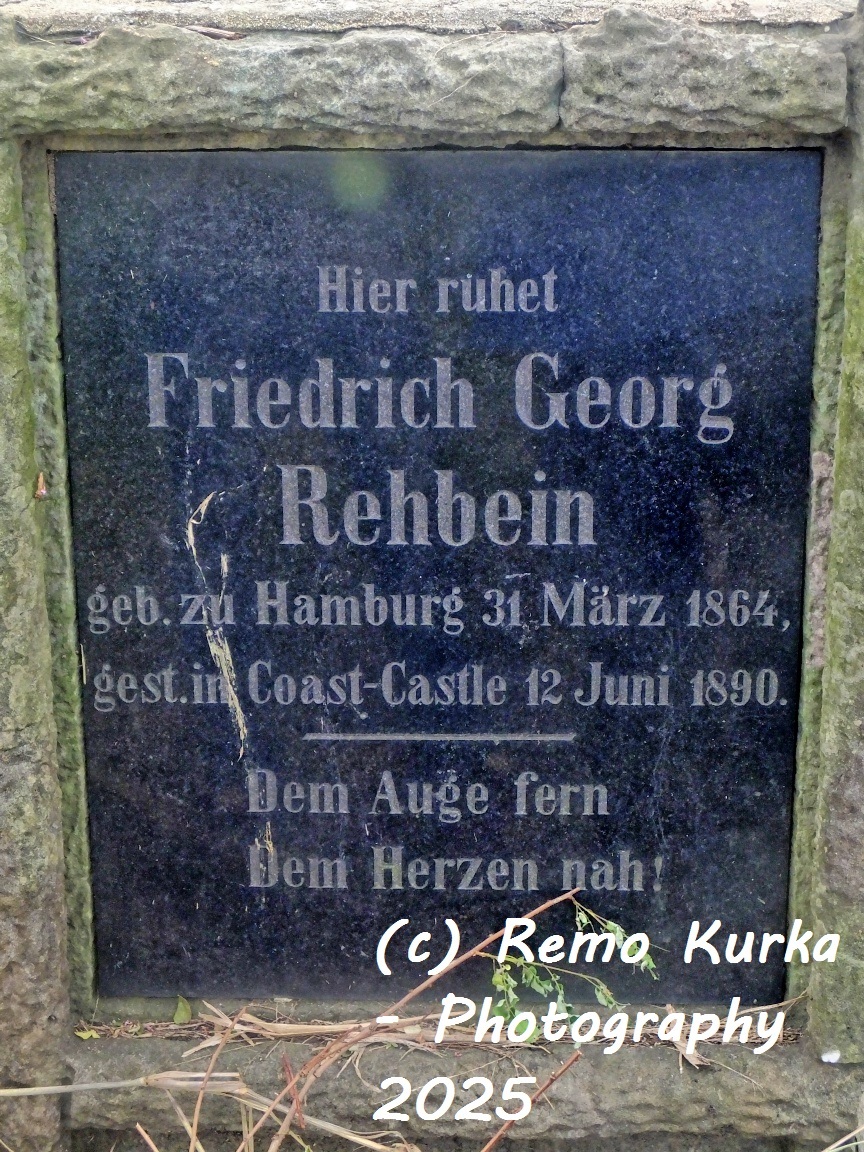
Unearthing History: Friedrich Georg Rehbein’s Gravestone in Cape Coast’s 1824 War Cemetery – A Young Hamburg Merchant Lost to the “White Man’s Grave”
Story, photos, and research by Remo Kurka (c) 2025 - Permission in writing is required to use any part of this text or research or photo!
Each gravestone in Cape Coast’s 1824 War Cemetery tells a story of ambition, sacrifice, and loss. Among them stands one of the most striking memorials: the polished black granite plaque of Friedrich Georg Rehbein, a young German merchant clerk from Hamburg. His epitaph, gilded in Gothic script, carries a message of enduring love across continents: “Far from the eye, near to the heart.”
This stone is not just a marker of death; it is a window into Hamburg’s merchant world, Germany’s colonial ambitions, and the perilous realities of life on the West African coast in the late 19th century.
This stone is not just a marker of death; it is a window into Hamburg’s merchant world, Germany’s colonial ambitions, and the perilous realities of life on the West African coast in the late 19th century.
1834 War CemeterySearch our Network. Start here.
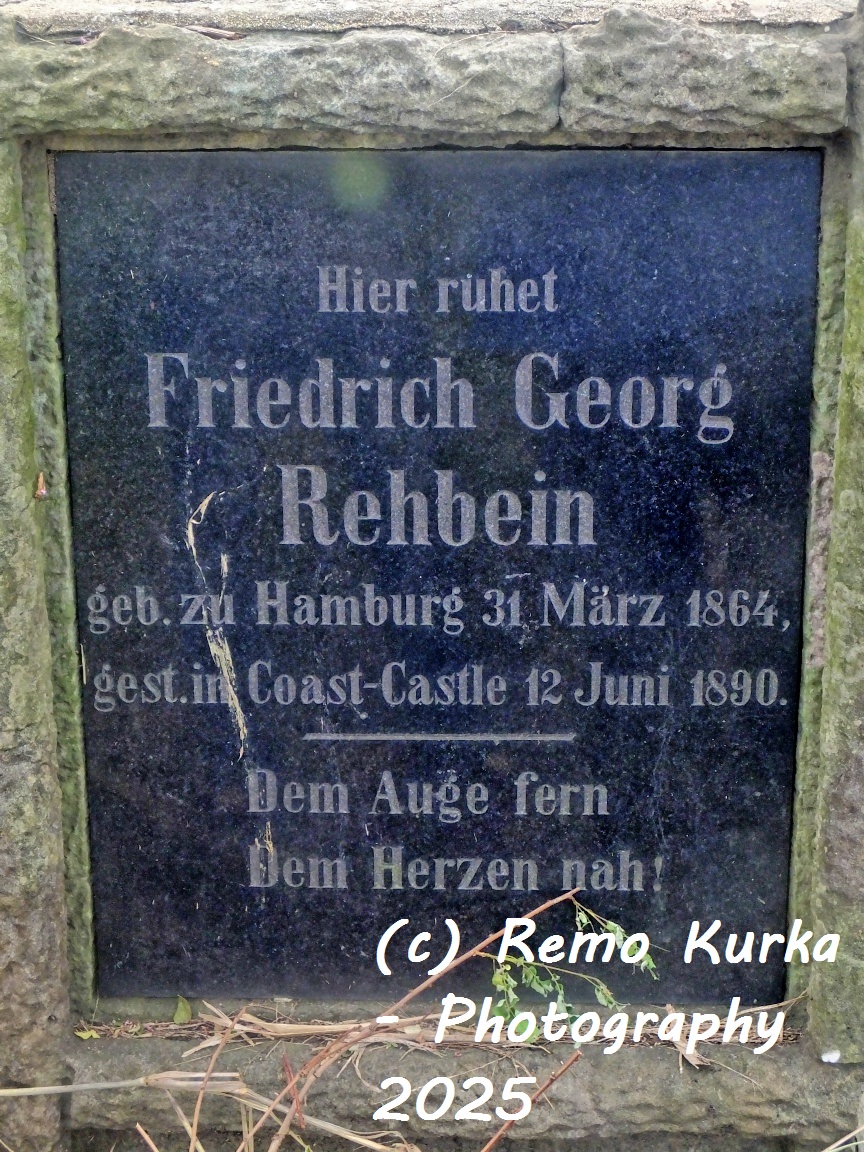
Georg Rehbein born in Hamburg 31 March 1864, died in Coast-Castle 12 June 1890.
To the eye far away, to the heart ever near!”
Transcription of the Gravestone
The memorial bears the following inscription, carefully preserved with its original phrasing and abbreviations:
Hier Ruht Georg Friedrich
Rebein
geb. zu Hamburg 31 Maerz 1864
gest. in Coast Castle 12 Juni 1890
Dem Auge Fern
Dem Herzen Nah
Friedrich Georg Rehbein
Born: 31 March 1864, Hamburg,
(German Empire)
Died: 12 June 1890,
Cape Coast Castle, Gold Coast
Age at death: 26 years and 2½ months
Full inscription (translated):
“Here rests Friedrich Georg
Rehbein
born in Hamburg 31 March 1864,
died in Coast-Castle 12 June 1890.
To the eye far away,
to the heart ever near!”
At just 26 years old, Rehbein died in Cape Coast Castle on 12 June 1890, barely two years into his overseas posting. His gravestone, carved in polished black granite with gilded Gothic lettering, reflects both his family’s standing and the pride of the Hamburg trading houses in commemorating their dead abroad.
Who Was Friedrich Georg Rehbein?
Friedrich Georg Rehbein was born on 31 March 1864 in Hamburg, then a free Hanseatic city and one of Europe’s busiest ports. The surname Rehbein was well established in northern Germany, with families recorded in Hamburg’s civil registers and merchant directories throughout the 19th century. His background places him firmly in Hamburg’s merchant middle class — respectable, educated, and closely tied to the city’s trading economy.
By the late 1880s, Hamburg’s great trading houses were sending dozens of young men abroad. Rehbein was almost certainly recruited by C. Woermann, the largest German commercial firm in West Africa. Founded in 1837, Woermann dominated the palm‑oil and palm‑kernel trade, with warehouses in Cape Coast, Accra, and Axim. Clerks like Rehbein were dispatched at ages 23–26 for two‑year tours, tasked with bookkeeping, managing shipments, and maintaining company accounts.
Historical Context
Hamburg’s Trading Boom: In the 1860s, Hamburg was thriving. Its merchants controlled shipping routes to Africa, Asia, and the Americas. Families like the Rehbeins supplied clerks to firms that expanded Germany’s reach overseas.
German Colonial Expansion: By 1884–85, Germany had annexed Togo and Cameroon, but the Gold Coast remained British. German firms nevertheless operated freely in Cape Coast, competing with British merchants.
Cape Coast Castle in 1890: The castle served as both British headquarters and a hub for European merchants. Its upper floors housed sick bays for Europeans, where many succumbed to tropical diseases.
Rehbein’s death on 12 June 1890 fits the tragic pattern: young men, newly arrived, struck down by malaria or blackwater fever within months. The average European life expectancy on the coast was less than 18 months.
The Epitaph
His epitaph reads:“Dem Auge fern, dem Herzen nah!” (“Far from the eye, near to the heart!”)
This phrase was common on German graves overseas, expressing emotional closeness despite physical separation. It was especially poignant for families who lost sons abroad, never to be repatriated. For Rehbein’s parents and kin in Hamburg, the inscription was a way of keeping him present in memory, even though he lay thousands of miles away in Cape Coast soil.
So here lies a 26-year-old boy from the Elbe who came chasing fortune in the palm-oil boom and instead became another statistic of the “White Man’s Grave.” His stone is one of the most perfectly preserved in the whole cemetery, a silent reminder that long after the 1824 British soldiers were forgotten, the German commercial empire was still losing its young men in exactly the same spot.
The 1824 War Cemetery
Originally established after the First Anglo‑Ashanti War, the cemetery became Cape Coast’s main European burial ground by the late 19th century. Rehbein’s grave, with its imported granite and gilded lettering, stands out among the simpler crosses and eroded stones. It reflects the pride Hamburg firms took in memorializing their employees. Stones were often cut in Germany and shipped to Africa; replacements were sent if originals decayed.
His grave thus represents not only personal loss but also the German commercial presence in a British colony — a reminder that Cape Coast was a crossroads of international trade and empire.
Legacy and Significance
Friedrich Georg Rehbein’s story embodies the risks faced by Hamburg’s merchant sons. At just 26, he became one of the many young men who sought fortune in Africa but instead met early death. His grave is a rare, pristine memorial, a silent witness to the human cost of empire, ambition, and commerce.
By documenting his life, we restore his name and dignity. He was not merely a statistic of the “White Man’s Grave,” but a son of Hamburg, a clerk of Woermann, and a young man remembered with love by his family. His epitaph bridges continents, connecting Hamburg’s merchant world to Cape Coast’s colonial past.
Sources
Hamburg civil registration records (births, 1864)
Woermann company histories (19th‑century expansion in West Africa)
German colonial epitaph traditions (19th‑century funerary inscriptions)