Unearthing History: A Welsh Gravestone in Cape Coast’s 1824 War Cemetery
Unearthing History: A Welsh Gravestone in Cape Coast’s 1824 War Cemetery
Each weathered inscription in the 1824 War Cemetery, Cape Coast, tells a deeply human story — and this gravestone is no exception. Its fading lines, carefully carved nearly two centuries ago, reveal the memory of a man far from home, remembered with devotion by his grieving family in Wales.
Through detailed transcription and cross-referenced research, this memorial has been brought back into focus — its biblical epitaph standing as a quiet testament to faith, loss, and endurance in a distant colonial outpost.
This discovery sheds light not only on the life of one individual, but on the broader history of British and European presence in 19th-century Ghana. Each restored detail connects present-day visitors to the human side of empire — where duty, belief, and remembrance converged on the shores of Cape Coast.
1834 War CemeterySearch our Network. Start here.
Transcription of the Gravestone
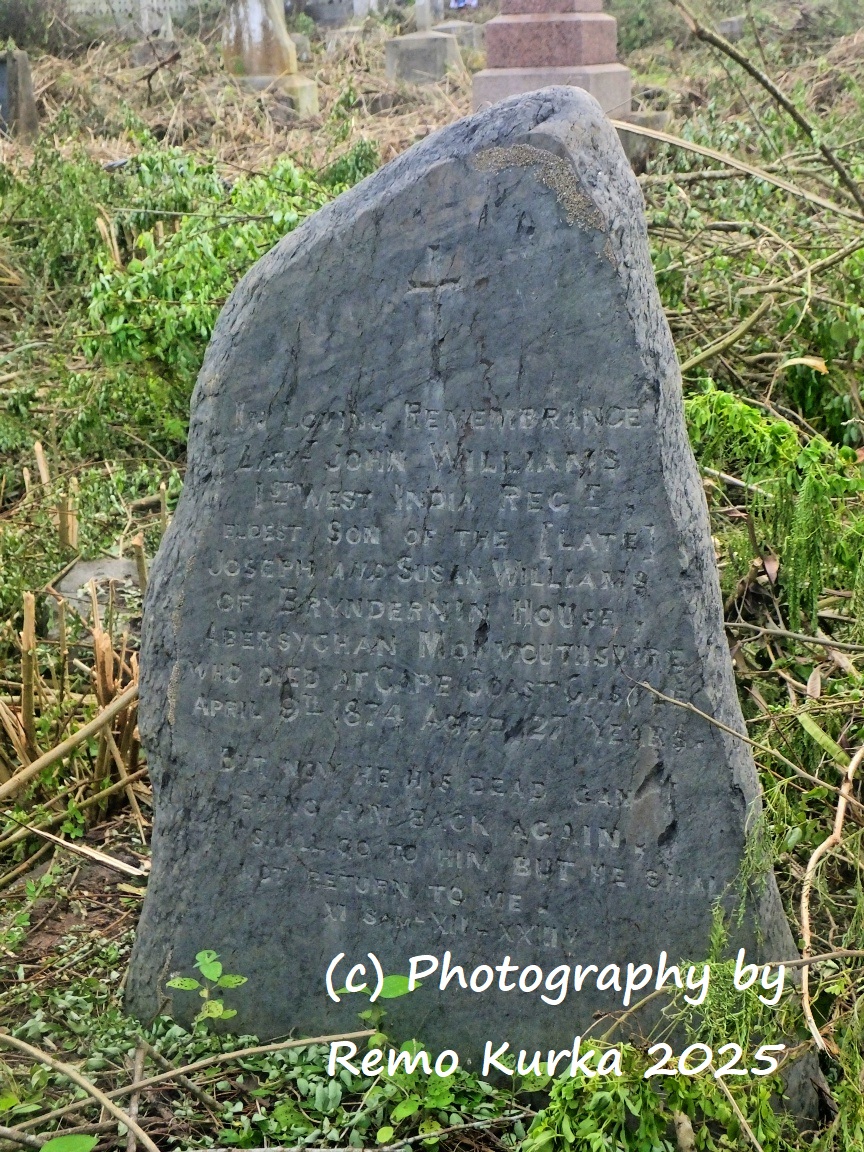
Crowned with a delicately carved stone cross, the memorial bears the following inscription, carefully preserved with its original phrasing and abbreviations:
IN LOVING REMEMBRANCE
OF
JOHN WILLIAMS
LIEUT. 2ND WEST INDIA REGT.
ELDEST SON OF THE LATE
JOSEPH WILLIAMS
OF BRYNDERWEN HOUSE
ABERSYCHAN, MONMOUTHSHIRE
WHO DIED AT CAPE COAST
APRIL 11TH 1874
AGED 27 YEARS
BUT THOUGH HE BE DEAD YET CAN
HE SPEAK AGAIN
UNTIL WE MEET AGAIN
Though the final lines are partly eroded, the words “Until we meet again” are faintly visible — a fitting, tender close that echoes many Victorian-era epitaphs of faith and remembrance.
The phrase “But though he be dead yet can he speak again” draws its inspiration from Hebrews 11:4, which reads, “…he being dead yet speaketh.” The inscription adapts this verse to convey the enduring voice of memory — a testament that even in death, Lieutenant John Williams continues to speak through this stone, standing for over a century in Cape Coast’s 1824 War Cemetery.

Who Was John Williams?
John Williams was born around 1847 in or near Abersychan (then in Monmouthshire, now Torfaen, Wales), the eldest son of Joseph Williams, a local gentleman and landowner. Brynderwen House was a notable residence in the area, associated with the Williams family in 19th-century directories and subscriber lists—Joseph appears as "Joseph Williams, Esq." in Welsh newspapers from the 1860s–70s, suggesting he was a man of some standing, possibly involved in local industry (Abersychan was a hub for ironworks and coal mining during the Industrial Revolution). Joseph had passed away by 1874 (hence "the late"), leaving John as the heir.
At age 27, John was serving as a Lieutenant in the 2nd West India Regiment (often abbreviated as 2nd WIR), a British colonial unit raised in the early 1800s primarily from West Indian recruits but officered by British men like John. The regiment was stationed in West Africa during this period, including the Gold Coast (modern Ghana), for garrison duties and to support British colonial interests.
His death on April 11, 1874, came just months after the end of the Third Anglo-Ashanti War (also called the Sagrenti War, 1873–74), a major conflict where British forces under Sir Garnet Wolseley defeated the Ashanti Empire to secure control over trade routes and the coastal protectorates. Cape Coast Castle served as the British headquarters, and thousands of troops (including the West India Regiments) were based there. While battle casualties were relatively low (around 18 British killed in action, per historical accounts), disease—especially malaria and dysentery—claimed far more lives, with estimates of 200–300 total British deaths from illness during the campaign. John likely succumbed to one of these tropical fevers, common among European officers unacclimated to the region. No battle records specifically name him as a combat casualty, so this fits the pattern of post-war garrison hardships.
The 1824 War Cemetery
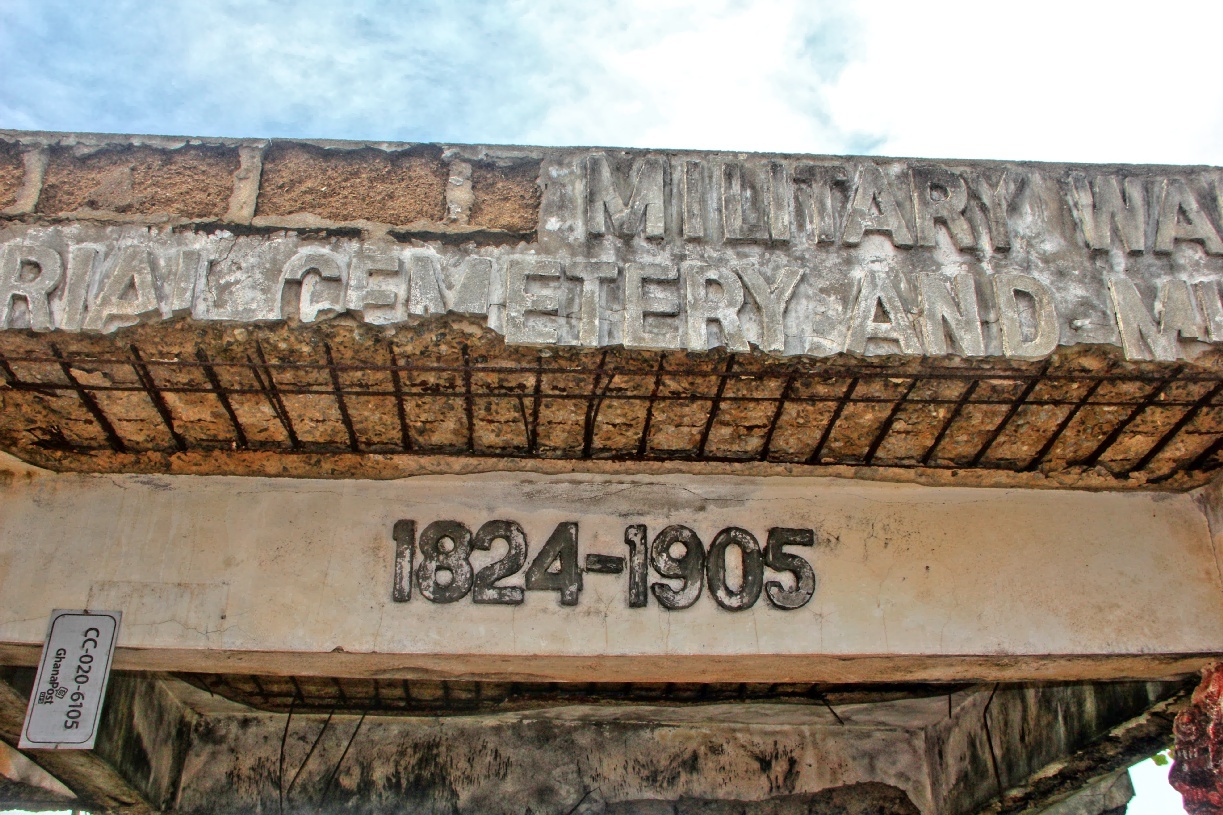
This gravestone is in the Military War Memorial Cemetery (often called the 1824 War Cemetery or 1824–1905 Military Cemetery) in Bakaano, just outside Cape Coast, Ghana. It's a small, evocative site holding about 50–60 graves of British soldiers, officers, and colonial officials from the 19th century. The "1824" refers to the First Anglo-Ashanti War (1823–31), when Ashanti forces attacked Cape Coast Castle on July 14, 1824, in a failed bid to disrupt British trade. The cemetery expanded over decades to include burials from later conflicts, like the Third War in 1873–74, up to the early 20th century.
Today, it's a quiet, overgrown spot near the castle (a UNESCO World Heritage site infamous for its role in the transatlantic slave trade). Restoration efforts have been ongoing—funded partly by groups like the Prince Claus Fund in 2010—but it's still a raw reminder of colonial violence and loss. Graves like John's highlight the human cost: young men far from home, buried in foreign soil. The site doubles as a museum of sorts, with plaques and artifacts from the wars.
Broader Context
The Anglo-Ashanti Wars (1824–1900) were brutal clashes over gold, timber, and influence in the Gold Coast. The British viewed the Ashanti as a threat to their expanding empire; the Ashanti saw the British as interlopers on their territory. By 1874, Wolseley's victory burned Kumasi (the Ashanti capital) and forced a treaty ceding coastal lands, but it sowed seeds for future resentment—leading to the final war in 1900. Units like the 2nd WIR were crucial, providing infantry for the humid interior where European troops struggled.