Cape Coast 1824 War Cemetery European Cemetery – The Grave That Refused to Stay Lost Catholic Reverend Sister Zenon (1872 – 23 June 1896)
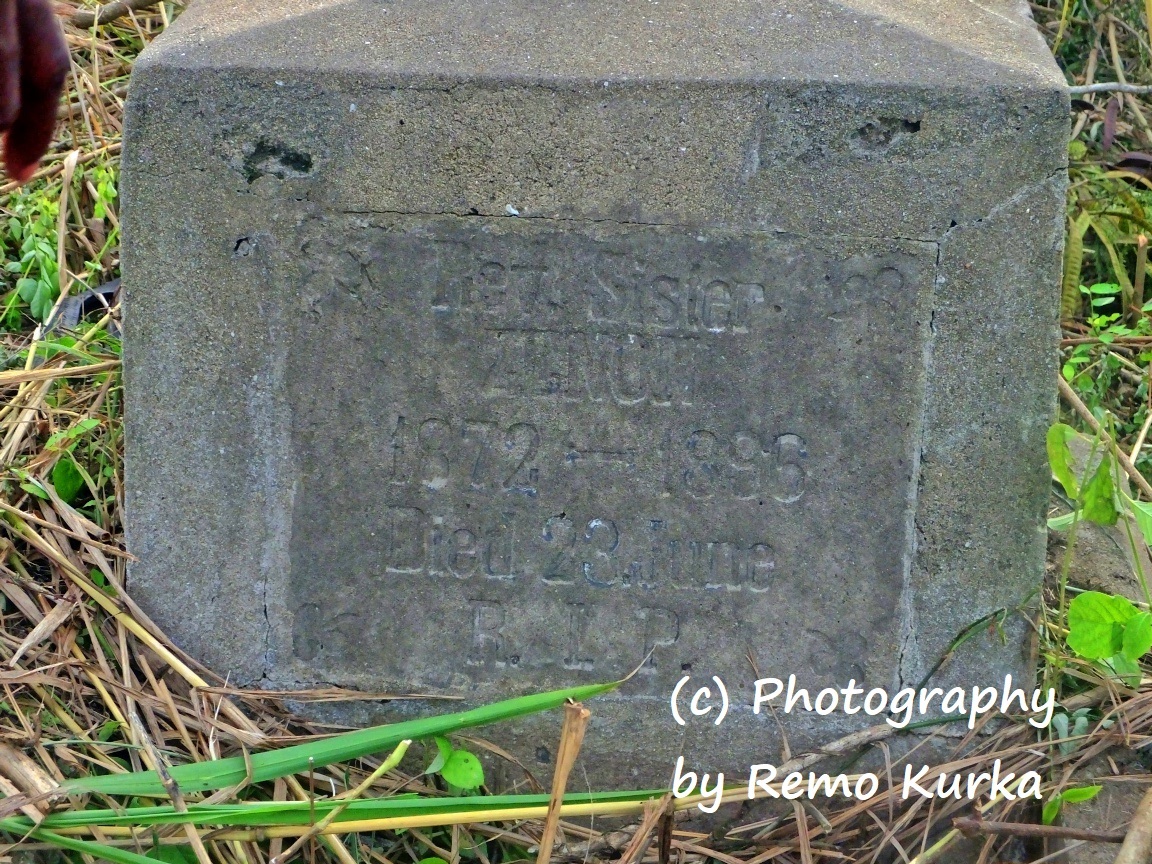
Unearthing History: Rev. Sister Zenon Gravestone in Cape Coast’s 1824 War Cemetery - Catholic Sisterhood
Story, photos, and research by Remo Kurka (c) 2025 - Permission in writing is required to use any part of this text or research or photo!
Cape Coast European Cemetery – The Grave That Refused to Stay Lost
A Catholic Reverend Sister Zenon (1872 – 23 June 1896)
For nearly 130 years, a small concrete cube lay half‑swallowed by vines in Cape Coast’s European Cemetery. Its inscription had faded to a blur, a ghost of letters. Generations of visitors passed it by, reading “Mercy,” “Mary,” or nothing at all, and walked on.
But stones do not forget. They wait. And in November 2025, one stubborn explorer refused to accept the silence. Armed with a Fuji camera, patience, and a noisy AI that kept misreading the letters, the stone was forced to speak again. After six high‑resolution photographs, four sleepless hours of zooming, and one heated argument between man and machine, the truth surfaced:
1834 War CemeterySearch our Network. Start here.
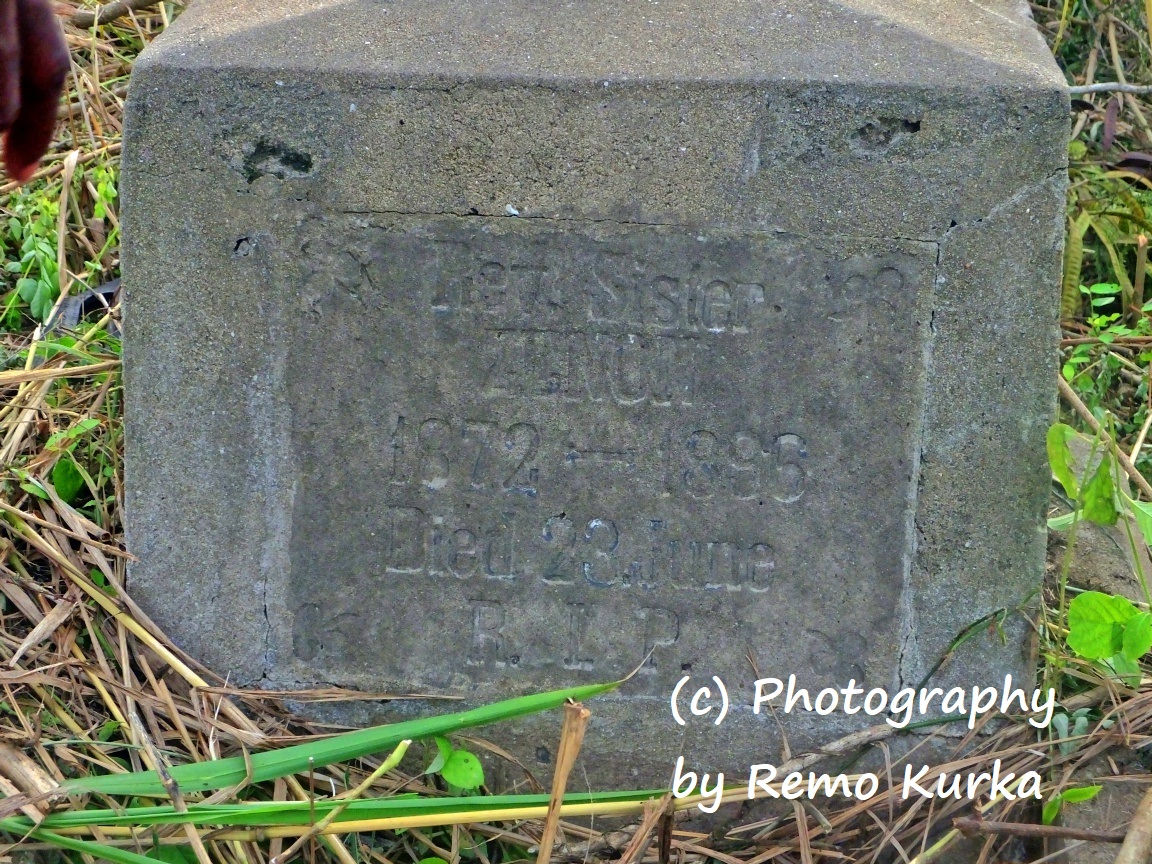
Reverend Sister Zenon (1872 – 23 June 1896)
For nearly 130 years, a small concrete cube lay half‑swallowed by vines in Cape Coast’s European Cemetery. Its inscription had faded to a blur, a ghost of letters
Transcription of the Gravestone
The memorial bears the following inscription, with its original phrasing and abbreviations:
Rev. Sister ZENON
1872 – 1896
Died 23 June
R.I.P.
She was twenty‑four years old. This hardly to read concrete block marks the grave of one of the most remarkable and least-known women buried in the entire cemetery: an African nun who belonged to the very first community of indigenous Ghanaian Catholic sisters.
Who She Was
We do not yet know whether “Zenon” was her birth name or the religious name she received when she joined the Sisters of Our Lady of the Apostles (O.L.A.). What is almost certain is that she was Ghanaian — one of the first local girls to take the veil in the 1890s, when the French congregation was desperately trying to root the Catholic mission in coastal soil.
The O.L.A. sisters had arrived in West Africa in the 1880s, determined to build a community of African women religious. It was a radical vision: that Ghanaian girls could become nuns, teachers, and caregivers, not just pupils or catechists. Sister Zenon was part of this fragile, pioneering experiment.
Her Life and Service
She lived and served in the shadow of Cape Coast Castle, probably teaching catechism to younger children or helping in the mission orphanage. The sisters worked tirelessly in schools and clinics, wearing heavy European habits in the brutal coastal heat.
But the “fever coast” spared few. Malaria, yellow fever, and dysentery swept through the mission compounds. On 23 June 1896, Sister Zenon succumbed, another young life claimed by the diseases that haunted Cape Coast. She was buried in the European Cemetery, among soldiers, merchants, and fellow sisters.
The Grave
Her grave is one of a small cluster of rough concrete blocks, poured and carved on the spot by mission workmen. They are modest compared to the pink granite obelisks of British officers, but they are the graves that hurt the most: young Ghanaian women and teenagers who gave their lives before their lives had truly begun, so that a church could take root here.
For decades, her stone was unreadable. But now, her name is spoken again.
Why This Grave Matters
Sister Zenon’s rediscovered grave is proof that the cemetery has not yet given up all its secrets. It reminds us that the dead are never finished talking; sometimes they just need someone persistent enough to keep asking questions at 3 a.m.
Her story is part of the quiet Africanisation of Catholicism in Ghana. Long before independence, long before the 20th century, African women were already shaping the Church with their vows, their teaching, and their sacrifice.
Her cracked stone is not just a marker of death. It is a symbol of resilience, devotion, and the power of memory restored.
Legacy
Rest in the peace you earned, Sister Zenon. Your name is spoken again, for the first time since the rains of 1896.
(Photographed, argued over, and restored to history, November 2025. Discovered and correctly read by Remo Kurka.)
Sources
Archives of the Sisters of Our Lady of the Apostles (O.L.A.), France and Ghana
Catholic mission histories in Ghana (Elmina, Cape Coast, Saltpond)
Missionary diaries of the 1880s–1890s (Society of African Missions, SMA)
Oral traditions of early Catholic sisters in Cape Coast